
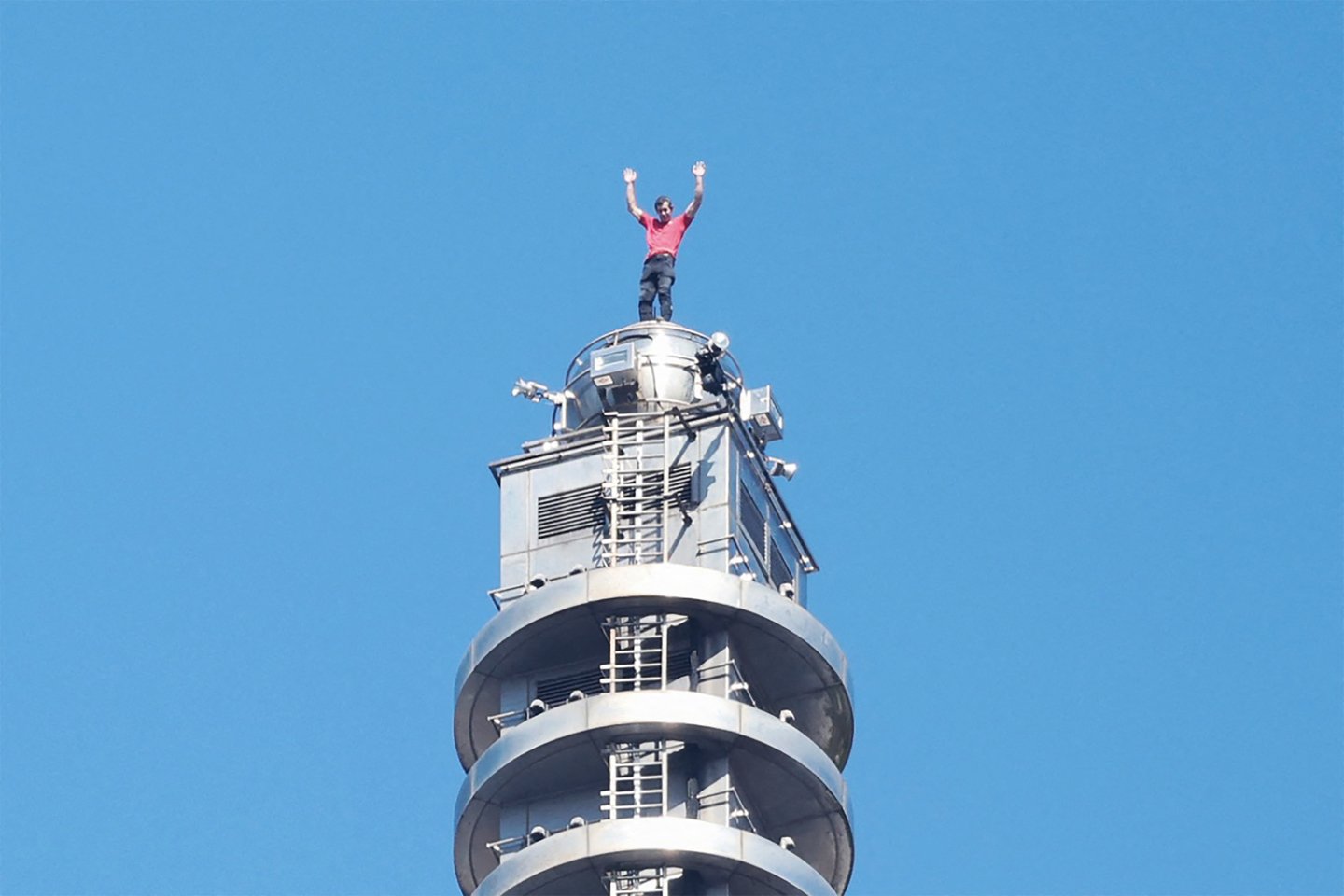
Alex Honnold has revealed new behind-the-scenes details about his terrifying live climb up Taipei 101, including how much he was paid for risking his life on one of the world’s tallest skyscrapers. The famous free solo climber reached the top of the 1,667-foot tower in Taiwan during Netflix’s Skyscraper Live, completing the challenge in 1 hour and 35 minutes. But despite the danger, global attention, and no safety ropes, Honnold says the paycheck was not as huge as many people might expect.
Alex Honnold Climbed Taipei 101 Live on Netflix
Alex Honnold climbed Taipei 101 as part of Netflix’s live event Skyscraper Live. The climb immediately drew attention because Taipei 101 is not a normal climbing route. It is a massive skyscraper with a difficult exterior design, towering high above Taipei.
The building is famous for its futuristic appearance and its huge tuned mass damper, which helps stabilize it during strong winds and earthquakes.
For a climber, the tower’s shape created a brutal challenge. The outside of Taipei 101 has stacked sections that flare outward, creating repeated ledges and overhangs.
That meant Honnold had to deal with multiple difficult sections before reaching the final narrow stretch near the top.
The climb lasted 1 hour and 35 minutes and was streamed live, making it one of the most intense televised climbing events in recent memory.
Why the Taipei 101 Climb Was So Dangerous
The Taipei 101 climb was dangerous because Honnold completed it without safety ropes. One mistake could have ended the attempt instantly.
Free solo climbing is already known as one of the most extreme forms of climbing because there is no protective rope system. On a natural rock wall, that is terrifying enough. On a skyscraper, the pressure becomes even stranger because of the building’s glass, metal, height, wind, and artificial structure.
Taipei 101 rises 1,667 feet, making it one of the tallest buildings in the world. The height alone made the event stressful for viewers.
The overhanging sections also added difficulty. Honnold could not simply climb straight upward. He had to handle repeated outward-flaring ledges before continuing.
The event was also live, which meant there was no editing, no second take, and no way to hide the pressure.
For many viewers, the most shocking part was how calm Honnold appeared while doing something that most people could barely watch.
Honnold Says the Pay Was “Embarrassing”
After the climb, Honnold was asked about how much he earned for the event. He did not give an exact figure, but he described the amount as “embarrassing.”
He clarified that the pay was not embarrassing because it was too much. Instead, he said that compared with mainstream sports, it was embarrassingly small.
Honnold compared the situation to major professional athletes who receive contracts worth hundreds of millions of dollars. In that context, he suggested his payout for climbing one of the world’s tallest buildings live on Netflix was far lower than people might imagine.
Reports have suggested that he may still receive a mid-six-figure amount. That is clearly a lot of money in ordinary terms, but Honnold’s point was about the scale of risk compared with the money paid in bigger sports industries.
His comment surprised fans because many assumed such a dangerous event would come with an enormous payday.
Why Honnold Says He Was Not Really Paid to Climb
Honnold explained that he does not think of the money as payment for the climb itself. In his view, he climbed the building because he wanted to and because he believed he could do it.
He said he would have climbed Taipei 101 for free if there had been no TV program and the building had simply given him permission.
That mindset is part of what makes Honnold so unusual. For most people, no amount of money would make the climb feel worth the risk. For him, the climb itself is the reward.
He described the chance to sit alone on the very top of the spire as an incredible experience. The physical challenge, mental focus, and rare access mattered more to him than the paycheck.
Instead, he said the money was really for the spectacle around the event. The cameras, live broadcast, promotion, pressure, and audience were what turned the climb into a paid production.
In his words, he was climbing the building for free and being paid for the spectacle.
Why He Did Not Have Life Insurance
One of the most surprising details was that Honnold reportedly did the climb without life insurance. When asked about it, he said insurance would have been too expensive.
He also shared a blunt opinion about insurance in general, saying he believes the system benefits companies more than ordinary people.
That detail made the story even more shocking because the climb involved extreme risk. Many viewers would assume a live event of this scale would involve huge insurance arrangements.
But Honnold’s career has always existed outside normal risk calculations. His most famous achievement, free soloing El Capitan in Yosemite, also required a level of calm and control that most people find almost impossible to understand.
For Honnold, risk is not about recklessness. He has often explained that he prepares obsessively, studies routes carefully, and only attempts climbs he believes he can complete.
Still, the absence of safety ropes and life insurance made the Taipei 101 climb feel even more unreal to many fans.
Why Alex Honnold Takes These Risks
Alex Honnold takes these risks because climbing is not just a job for him. It is the center of his life, identity, and personal challenge.
He is known for approaching fear differently from most people. Rather than being driven by adrenaline alone, he is famous for preparation, discipline, and emotional control.
Honnold has often said that he does not want to feel reckless. He wants to feel ready.
That is why his climbs are so fascinating. From the outside, they look impossible and terrifying. From his perspective, they are the result of training, repetition, planning, and confidence.
Taipei 101 offered something different from a natural rock wall. It was an urban, modern, public version of the same mental challenge: climb something extremely difficult with total focus.
The money may have mattered, but it clearly was not the main motivation.
Why the Story Went Viral
The story went viral because people were stunned that a climber could risk so much and still describe the pay as relatively small. It also exposed the difference between extreme adventure sports and mainstream sports.
A baseball, football, or basketball star can earn enormous contracts while competing in structured arenas with teams, rules, and safety systems. Honnold’s climb involved one person, one building, and no rope.
That contrast made people question how risk, entertainment, and value are measured.
The story also gained attention because Honnold is already a legendary figure after Free Solo. Any new climb involving him naturally attracts curiosity, but Taipei 101 added a live-broadcast element that made it feel even more intense.
Fans were also fascinated by his attitude. Most people would focus on money, fear, or safety. Honnold talked about the climb as something he simply wanted to do.
That calmness is exactly why he remains one of the most compelling athletes in the world.
Key Takeaways
- Alex Honnold climbed the 1,667-foot Taipei 101 skyscraper live on Netflix.
- The climb took 1 hour and 35 minutes and was completed without safety ropes.
- Honnold said his pay was an “embarrassing” amount compared with mainstream sports contracts.
- Reports suggest he may still earn a mid-six-figure sum from the event.
- He said he was not really paid to climb the building, but paid for the spectacle around it.
- Honnold also revealed he did not have life insurance for the climb because it would have been too expensive.