
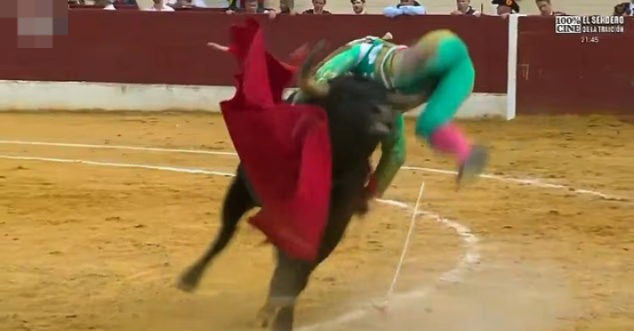
A Spanish matador was seriously injured after being gored during a bullfight in Valdemoro, Madrid, leaving spectators shocked as the incident unfolded in the ring. The bullfighter, identified as 36-year-old Albert Duran, was taking part in the final qualifying round of the Copa Chenel when the bull caught him and lifted him into the air. He was rushed for emergency treatment and later underwent surgery, with reports saying his condition became stable after medical care.
Matador Albert Duran Injured in Valdemoro Bullfight
Albert Duran was competing in a bullfighting event in Valdemoro when the incident happened. Footage from the arena showed the bull charging at him before catching him in the lower body area and tossing him upward as the crowd reacted in horror.
The moment was especially shocking because it happened in front of spectators who had been watching the final qualifying round of the Copa Chenel, a well-known bullfighting competition in Spain.
Medical staff quickly moved to assist Duran after the bull released him. He was taken from the ring and transported for urgent hospital care.
Reports said he required emergency surgery and later needed a second procedure after doctors found a blood clot. His condition was later described as stable and improving in intensive care.
Crowd Reacted in Horror as Incident Unfolded
The arena crowd could be heard reacting loudly as Duran was struck and lifted by the bull. These moments often create intense scenes because bullfighting spectators understand the risk, but serious injuries still shock the audience when they happen suddenly.
Bullfighting is built around danger, timing, and close movement between the matador and the animal. Even experienced performers can be injured if they misjudge the bull’s movement by a fraction of a second.
In Duran’s case, the bull appeared to catch him with force, leaving little time for others in the ring to intervene.
Assistants and medical teams are usually present at these events because severe injuries can happen quickly. Their fast response can make a major difference in survival and recovery.
Surgery and Recovery Updates
After being taken to hospital, Duran reportedly underwent emergency surgery for the injury. A second operation was later needed after doctors discovered a blood clot.
Reports said he remained in intensive care but was stable and improving after treatment. That update brought some relief to supporters and others in the bullfighting community.
Recovery from this type of injury can be slow and painful. It may involve surgery, monitoring for infection, physical rest, and later rehabilitation depending on the damage.
For matadors, recovery is not only physical. A serious incident in the ring can also affect confidence, timing, and mental readiness to return.
At this stage, the most important concern is Duran’s health and long-term recovery.
Spain Has Seen Several Recent Bullfighting Injuries
Duran’s injury comes during a difficult period for Spanish bullfighting, with several serious incidents reported in recent weeks.
Raúl Ruiz was injured at Madrid’s Las Ventas arena after a bull’s horn caused a deep thigh wound during a novillada event. Reports said the injury caused significant muscle damage and heavy blood loss.
Another major case involved Morante de la Puebla, one of Spain’s best-known matadors, who suffered a severe lower-body injury during a bullfight in Seville and required hours of surgery.
There was also a fatal incident involving former matador Ricardo Ortiz in Malaga while handling bulls ahead of an event.
These cases have renewed debate over the dangers of bullfighting and whether the tradition should continue.
Why Bullfighting Remains So Controversial
Bullfighting remains one of Spain’s most debated traditions. Supporters see it as part of cultural heritage, artistry, courage, and regional identity.
They argue that bullfighting has deep historical roots and that matadors accept the risk as part of the profession.
Critics strongly disagree. Animal welfare groups argue that the practice causes unnecessary suffering and should be ended. They also point to the serious danger faced by humans in the ring.
The debate is especially emotional because bullfighting carries different meanings in different parts of Spain. In some regions, it remains a major cultural event. In others, it has been restricted or rejected.
Incidents like Duran’s injury often bring the debate back into public focus because they show how dangerous the spectacle can be for everyone involved.
The Risk Matadors Face Every Time
Matadors face serious risk every time they enter the ring. Bulls are powerful, fast, and unpredictable, and even trained professionals cannot fully control what happens.
A bull can change direction suddenly, charge faster than expected, or catch a matador off balance.
The clothing and movements of a matador may look graceful from the stands, but the distance between performance and disaster is very small.
This is why serious injuries are not rare in bullfighting history. Many matadors have been hurt during events, and some have lost their lives.
Duran’s case is another reminder that bullfighting is not only a show. It is a dangerous encounter with real consequences.
Key Takeaways
- Spanish matador Albert Duran was seriously injured during a bullfight in Valdemoro, Madrid.
- The incident happened during the final qualifying round of the Copa Chenel.
- He was taken to hospital and reportedly underwent emergency surgery.
- Reports said he later needed a second procedure after doctors found a blood clot.
- His condition was later described as stable and improving in intensive care.
- The incident follows several recent serious bullfighting injuries in Spain.
- The case has renewed debate over the danger and controversy surrounding bullfighting.
Albert Duran’s injury is a stark reminder of the extreme risk behind bullfighting, a tradition that continues to divide Spain between cultural pride and growing concern over safety and animal welfare.