
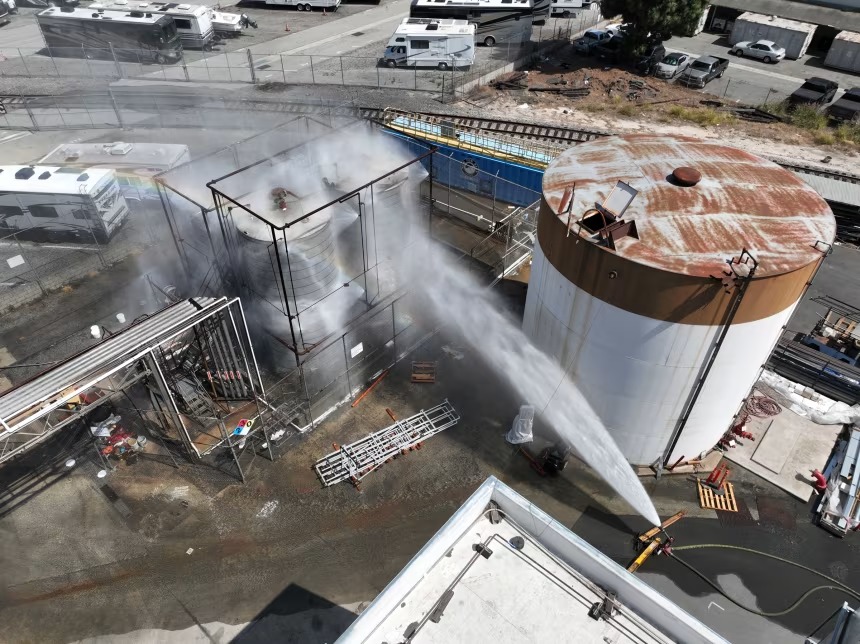
A dangerous chemical emergency in Orange County, California, has forced nearly 40,000 residents to evacuate after officials warned a large industrial storage tank could either leak toxic material or expl⌀de. Emergency crews spent hours trying to stabilize the failing tank as concerns grew about possible toxic vapor exposure across several Southern California communities.
The incident began at a GKN Aerospace facility in Garden Grove, where a massive tank containing methyl methacrylate started overheating and releasing hazardous vapor. Officials described the situation as highly unstable and warned residents to immediately follow evacuation orders.
What Caused the Orange County Chemical Emergency?
The Orange County emergency started after a storage tank holding thousands of gallons of methyl methacrylate experienced serious pressure and valve problems. The chemical is commonly used in plastics and aerospace manufacturing but becomes highly dangerous when temperatures rise uncontrollably.
Authorities said the tank initially began venting hazardous vapor into the air Thursday afternoon. Although emergency crews temporarily stabilized conditions, officials later confirmed that a damaged valve created additional operational problems overnight.
Orange County Fire Authority officials warned that only two outcomes remained possible: the tank could rupture and spill thousands of gallons of hazardous material, or it could experience thermal runaway and expl⌀de.
Officials Describe Situation as “In Crisis”
Fire officials publicly described the chemical tank as being “actively in crisis” as crews raced to prevent further escalation. Authorities confirmed the damaged tank still contained roughly 6,000 to 7,000 gallons of hazardous material.
The unstable condition prompted emergency officials to rapidly expand evacuation zones into nearby cities.
Which California Cities Were Ordered to Evacuate?
Mandatory evacuation orders expanded beyond Garden Grove into multiple neighboring Orange County communities. Residents in portions of Anaheim, Cypress, Stanton, Buena Park, and Westminster were also told to leave affected areas.
Authorities estimated roughly 40,000 people fell under evacuation orders during the height of the emergency. Officials also reported that some residents refused to leave despite repeated public safety warnings.
Disneyland Was Not Under Evacuation Orders
Despite the large emergency response, Disneyland Resort was reportedly not included within the mandatory evacuation zone. Garden Grove sits less than a mile from parts of the Anaheim resort district, which increased public concern online as news spread rapidly across social media.
Emergency shelters were opened for displaced residents as local agencies coordinated transportation and temporary housing support.
Why Is Methyl Methacrylate Considered Dangerous?
Methyl methacrylate is a volatile industrial chemical used to manufacture acrylic plastics, resins, and aerospace materials. Health officials warned that exposure to concentrated vapor can cause breathing problems, eye irritation, dizziness, nausea, and headaches.
Experts also explained that the substance becomes especially hazardous when exposed to rising temperatures or pressure buildup inside sealed tanks.
Toxic Vapor and Expl⌀sion Risks Raised Concern
Emergency responders feared the tank could either release hazardous vapor into nearby neighborhoods or create a larger industrial expl⌀sion affecting surrounding chemical storage areas.
Firefighters used remotely operated cooling systems and water equipment to lower tank temperatures while keeping personnel at safer distances.
Containment barriers and sandbags were also installed to help prevent possible chemical runoff from reaching storm drains, waterways, or coastal areas.
Emergency Crews Continue Monitoring the Situation
Hazmat specialists from across California continued monitoring the damaged tank while coordinating with industrial chemical experts nationwide. Authorities stated that temperatures had temporarily stabilized, buying crews more time to search for safer containment options.
Officials stressed, however, that the threat had not fully ended and that evacuation orders remained critical for public safety.
Air Quality Monitoring Ongoing
Health officials reported that no dangerous airborne chemical concentrations had yet been detected outside the immediate evacuation zone. However, responders continued tr@cking air conditions closely due to the possibility of sudden changes if the tank failed.
Governor Gavin Newsom’s office confirmed that California emergency agencies were assisting local authorities during the ongoing response operation.
Why the California Chemical Incident Matters
The Garden Grove incident has raised broader concerns about industrial chemical safety near densely populated residential communities. Thousands of families were forced to evacuate with little warning as officials struggled to contain an increasingly unstable situation.
The emergency also highlighted how quickly industrial incidents can escalate when hazardous materials, equipment failures, and high population density intersect.
Investigators are expected to review what triggered the initial tank malfunction once the situation is fully stabilized.
Key Takeaways
- Nearly 40,000 residents were evacuated during a California chemical emergency.
- The incident involved a failing tank containing methyl methacrylate at a Garden Grove aerospace facility.
- Officials warned the tank could leak hazardous chemicals or expl⌀de.
- Evacuation zones expanded into several Orange County cities.
- Emergency crews continued monitoring vapor conditions and cooling the unstable tank.
As emergency teams continue working to stabilize the site, many Southern California residents are still waiting to learn when it will finally be safe to return home.