
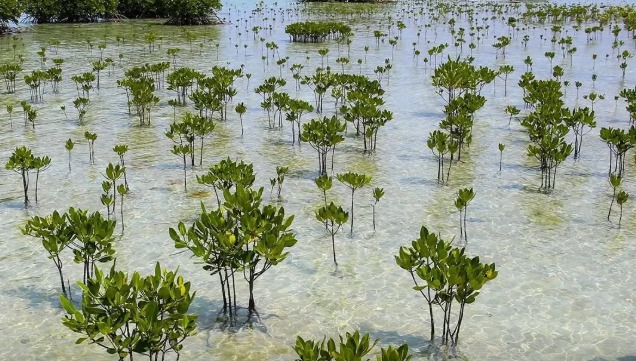
The world’s mangrove forests are showing encouraging signs of recovery after decades of destruction, according to a new scientific study that reveals these vital coastal ecosystems are expanding once again.
Researchers found that since 2010, global mangrove gains have begun to outpace losses, marking a significant turnaround for one of the planet’s most important natural defenses against climate change and coastal disasters.
The recovery is being driven by stronger environmental protections, growing public awareness, and the extraordinary ability of mangroves to regenerate naturally when human pressures are reduced.
Why Mangroves Matter
Mangrove forests are among the most valuable ecosystems on Earth. Found along tropical and subtropical coastlines, these unique trees thrive in salty environments and provide a wide range of environmental benefits.
Scientists estimate that mangroves can store up to five times more carbon dioxide than many land-based forests, making them powerful tools in the fight against climate change.
Their dense root systems also act as natural barriers against storms, coastal flooding, and tsunamis. By slowing powerful waves before they reach shore, mangroves help protect millions of people living in vulnerable coastal communities.
In addition, these forests provide essential breeding grounds and shelter for fish, crabs, shrimp, and numerous marine species, supporting local fisheries and biodiversity.
Decades of Destruction
Despite their importance, mangrove forests have faced extensive destruction over the past century.
Rapid expansion of fish farms, agriculture, urban development, and coastal construction led to widespread clearing of mangrove habitats across Asia, Africa, and the Americas.
Between the 1980s and 2010, more than 12,000 square kilometers of mangroves disappeared worldwide—an area roughly equivalent to the size of Jamaica.
Environmental experts warned that continued losses could increase climate risks, weaken coastal protection, and threaten marine ecosystems.
New Research Reveals Positive Trend
The latest study offers a much more optimistic picture.
Researchers found that total net losses since the 1980s have now been reduced dramatically to approximately 849 square kilometers.
More importantly, natural regeneration is helping forests recover in many regions where deforestation has slowed.
Scientists say mangroves possess a remarkable ability to rebound once human activities stop damaging them.
As legal protections strengthened and awareness increased, many degraded areas began recovering without extensive human intervention.
Indonesia and Myanmar Lead Recovery
Some of the strongest recovery has been recorded in Indonesia and Myanmar, two countries with extensive mangrove coverage.
In Indonesia, public attitudes toward mangrove conservation shifted significantly following the devastating Indian Ocean tsunami in 2004.
Communities observed that areas protected by mangrove forests suffered less damage during the disaster, leading to greater appreciation of their protective value.
As a result, clearing forests for aquaculture and development slowed considerably, allowing natural regeneration to occur.
Myanmar experienced similar changes after Cyclone Nargis in 2008, while government restrictions on logging further supported forest recovery.
Technology Improves Forest Monitoring
Researchers also credit advances in satellite technology for providing a more accurate understanding of mangrove growth.
Using high-resolution Landsat satellite imagery, scientists were able to detect forest expansion that earlier assessments may have overlooked.
The improved monitoring system allowed researchers to track subtle canopy changes and identify previously unrecorded areas of regeneration.
Experts say this new technology provides one of the most comprehensive assessments of global mangrove health ever conducted.
Not All Growth Is Positive
While the findings are encouraging, scientists caution that some mangrove expansion may be linked to environmental damage elsewhere.
In countries such as Brazil, increased nutrient flows from upstream deforestation, mining activities, and land degradation may be contributing to mangrove growth downstream.
Although mangroves benefit from these additional nutrients, the environmental consequences for upstream ecosystems can be severe.
Researchers stress that forest expansion should be evaluated alongside broader environmental conditions to ensure recovery is truly sustainable.
Ongoing Threats Remain
Despite overall improvements, several regions continue to face serious challenges.
West and Central Africa remain hotspots for mangrove destruction, with pollution, industrial development, and resource extraction threatening large areas of forest.
The Niger Delta, in particular, continues to experience significant environmental pressures due to oil pollution and infrastructure development.
Scientists also warn that tropical cyclones remain one of the biggest threats to mangrove ecosystems worldwide.
Powerful storms can destroy vast areas of forest within a single season, causing some of the largest annual losses recorded in recent decades.
Healthier Forests, Stronger Climate Protection
The study found not only that mangrove coverage is increasing, but that many existing forests are becoming healthier as well.
Since the 1980s, the proportion of dense, closed-canopy mangrove forests—those with the highest carbon storage capacity—has increased by nearly 20%.
These mature forests play a crucial role in absorbing greenhouse gases and supporting biodiversity.
Researchers believe this improvement highlights the resilience of mangroves and demonstrates the positive impact of conservation efforts.
Looking Ahead
Scientists remain optimistic about the future of mangrove forests.
While challenges persist, the combination of stronger protections, reduced deforestation, restoration projects, and natural regeneration appears to be reversing decades of decline.
Experts say the findings offer an important reminder that ecosystems can recover when given the opportunity.
Protecting existing mangroves and supporting sustainable management practices could provide major benefits for climate action, coastal resilience, and biodiversity conservation in the years ahead.
Key Takeaways
- Global mangrove forests have begun expanding faster than they are being lost since 2010.
- Mangroves store significantly more carbon than many land-based forests.
- Natural regeneration has become a major driver of forest recovery.
- Indonesia and Myanmar have seen particularly strong improvements.
- New satellite technology revealed greater forest growth than previously recorded.
- Some regions, especially West and Central Africa, continue facing significant threats.
- Healthier mangrove forests strengthen climate protection and coastal resilience.
The study offers rare environmental good news, showing that with effective conservation and reduced human pressure, one of the world’s most important ecosystems can recover and thrive once again.