
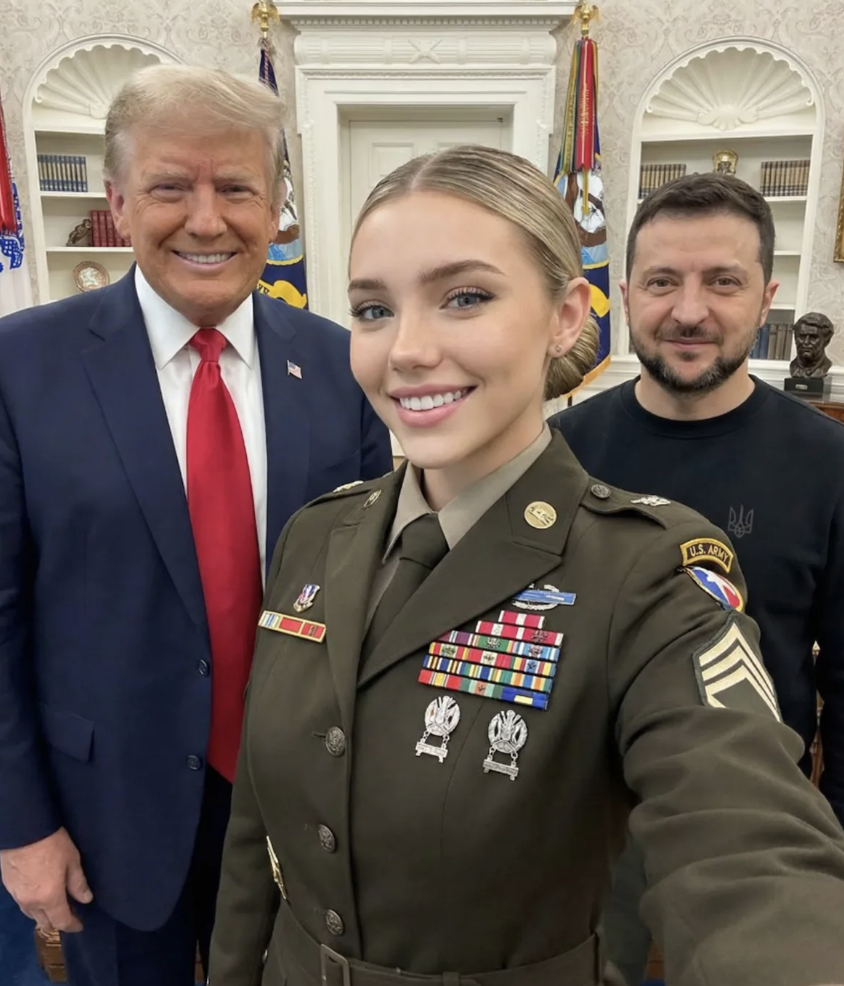
An AI army influencer known as Jessica Foster has sparked serious concern after millions of social media users appeared to believe she was a real U.S. military woman supporting Donald Trump. The account showed a glamorous blonde soldier posing with Trump, appearing on warships, standing with world leaders, and promoting an “America First” message. But the viral star was not a real person at all. She was created with artificial intelligence, raising fresh questions about fake influencers, political manipulation, and how easily AI images can fool people online.
AI Army Influencer Jessica Foster Goes Viral
Jessica Foster became a viral figure by presenting herself as a patriotic U.S. Army woman with a strong pro-Trump identity. Her photos showed her in military-style clothing, surrounded by political symbols, and appearing in places that made her look close to major world events.
To casual viewers, the images looked convincing enough. Many people commented on her appearance, praised her patriotism, and treated her like a real political supporter.
The account reportedly gained more than one million followers in only a few months. That level of growth is unusual, especially for an account built around a person who did not actually exist.
Her posts used a powerful mix of themes: military service, beauty, patriotism, Trump support, and global conflict. That combination made the account highly shareable among certain political audiences.
The problem is that the entire identity appears to have been AI-generated. Jessica Foster was not a real soldier, public figure, or verified military member. She was an artificial persona designed to attract attention.
How the Fake Influencer Fooled So Many People
The fake influencer fooled so many people because modern AI images have become far more realistic than older versions. In the past, AI-generated people often had strange hands, distorted faces, uneven eyes, or obvious background errors.
Today, those mistakes can be much harder to spot. A single image appearing in a busy social media feed may look real enough for people to like, share, or comment before questioning it.
Jessica Foster’s account also used emotional triggers. A beautiful military woman supporting Trump was exactly the type of image certain users wanted to believe.
That matters because people are more likely to accept content that matches their beliefs, values, or political identity. If an image feels emotionally satisfying, viewers may not stop to check whether it is real.
The account also posted repeatedly and tied itself to current events. That made the persona feel active, relevant, and connected to the news cycle.
In other words, the account did not need to be perfect. It only needed to be believable enough for fast-scrolling users who already liked the message.
What Kind of Images Did the Account Post?
The account posted AI-generated images showing Jessica Foster in highly dramatic situations. Some images claimed she was aboard a U.S. warship in the Strait of Hormuz, while others showed her posing with Donald Trump, Vladimir Putin, Volodymyr Zelensky, and other major public figures.
The photos were designed to look like proof that she was close to power. By placing her near political leaders and military settings, the account created an illusion of importance.
Some posts also showed her in glamorous poses, mixing military themes with influencer-style presentation. This helped the account attract both political engagement and personal admiration.
The combination was carefully effective. Followers were not only reacting to politics; they were reacting to an attractive invented personality who seemed to represent their worldview.
That is why the account became more than a fake profile. It became a digital character that people emotionally invested in.
For many followers, Jessica Foster was not just another account. She looked like a symbol of patriotism, confidence, beauty, and loyalty to Trump.
Why the OnlyFans Link Raised More Questions
The situation became even more concerning when reports said the Instagram account was linked to an OnlyFans account. That suggested the fake political influencer may also have been used to drive users toward a paid or adult-oriented platform.
OnlyFans reportedly removed the linked account because the creator was not verified. That detail matters because platforms usually require real identity checks to reduce fraud, impersonation, and exploitation.
The possible connection between political AI content and paid adult-style content raised major questions. Was the account built mainly for politics, profit, attention, or all three?
Some experts described the strategy as attention harvesting. The fake account used political identity to gain trust, then possibly directed followers toward another platform.
This is one of the biggest dangers of AI personas. They can be used not only to spread political messages, but also to build audiences, sell products, collect data, or push followers into paid spaces.
When fake identities become emotionally convincing, followers may spend money, share personal information, or spread propaganda without realizing the person does not exist.
Why Political AI Accounts Are So Dangerous
Political AI accounts are dangerous because they can create fake social proof. If thousands or millions of people interact with an AI-generated figure, the account can make a political message look more popular, personal, and authentic than it really is.
A fake person can post endlessly, never get tired, and be shaped to fit exactly what an audience wants. They can look patriotic, relatable, attractive, angry, heroic, religious, or emotional depending on the target group.
This can influence how people feel about real events. A fake military-themed account, for example, can push opinions about war, national security, immigration, elections, or political leaders while appearing to speak from lived experience.
That is especially serious when the account uses military imagery. Uniforms and service-related themes carry trust. Many users may assume the person has authority or real-world experience.
If the person is fake, that trust is being manipulated.
The Jessica Foster case shows how AI can turn politics into performance. A made-up character can become a powerful messenger because people respond to the image before they question the source.
How to Spot an AI-Generated Influencer
AI-generated influencers can be hard to spot, but there are warning signs. One clue is an account that looks extremely polished while offering little verifiable real-life history.
Check whether the person has real videos, interviews, public records, tagged photos from real people, and consistent appearances across different settings. AI personas often rely heavily on staged-looking images.
Look closely at details such as hands, teeth, badges, background text, shadows, uniforms, and reflections. AI can still make mistakes, especially in small visual details.
Another warning sign is impossible access. If a new influencer appears to be casually posing with world leaders, attending major global events, and standing in restricted military locations, that should raise questions.
Reverse image searches can also help. If similar images appear elsewhere or the account has no real history before a certain date, it may be artificial.
Most importantly, slow down before sharing. Viral political images are often designed to trigger emotion before critical thinking.
Why This Story Matters Beyond Trump Supporters
This story matters beyond Trump supporters because AI deception can target any political group. Today it may be a fake pro-Trump military influencer. Tomorrow it could be a fake activist, fake journalist, fake nurse, fake soldier, fake disaster victim, or fake protest organizer.
The technology itself is not limited to one ideology. Anyone with the right tools can create a convincing person and build a following around them.
That makes the Jessica Foster case a warning for all internet users. Political identity can make people vulnerable when content flatters their side or confirms what they already believe.
Fake influencers can also deepen division. They can post emotional content, provoke anger, spread rumors, and make real people argue over something created by software.
As AI tools improve, the line between real and fake online personalities will become harder to see. Platforms, journalists, and users will all need stronger verification habits.
The biggest lesson is simple: a convincing face is no longer proof of a real person.
Key Takeaways
- Jessica Foster was a viral AI-generated “army influencer” who appeared to fool many Trump supporters.
- The account showed fake images of her with Donald Trump, world leaders, military settings, and patriotic themes.
- Reports said the account gained more than one million followers before being removed.
- The profile was reportedly linked to an OnlyFans account, raising questions about profit and manipulation.
- The case shows how AI-generated personas can be used to harvest attention, push politics, and fool social media users.
The Jessica Foster story is a warning that the next viral political influencer may not be a real person at all, but a carefully designed AI character built to win trust, clicks, and influence.