
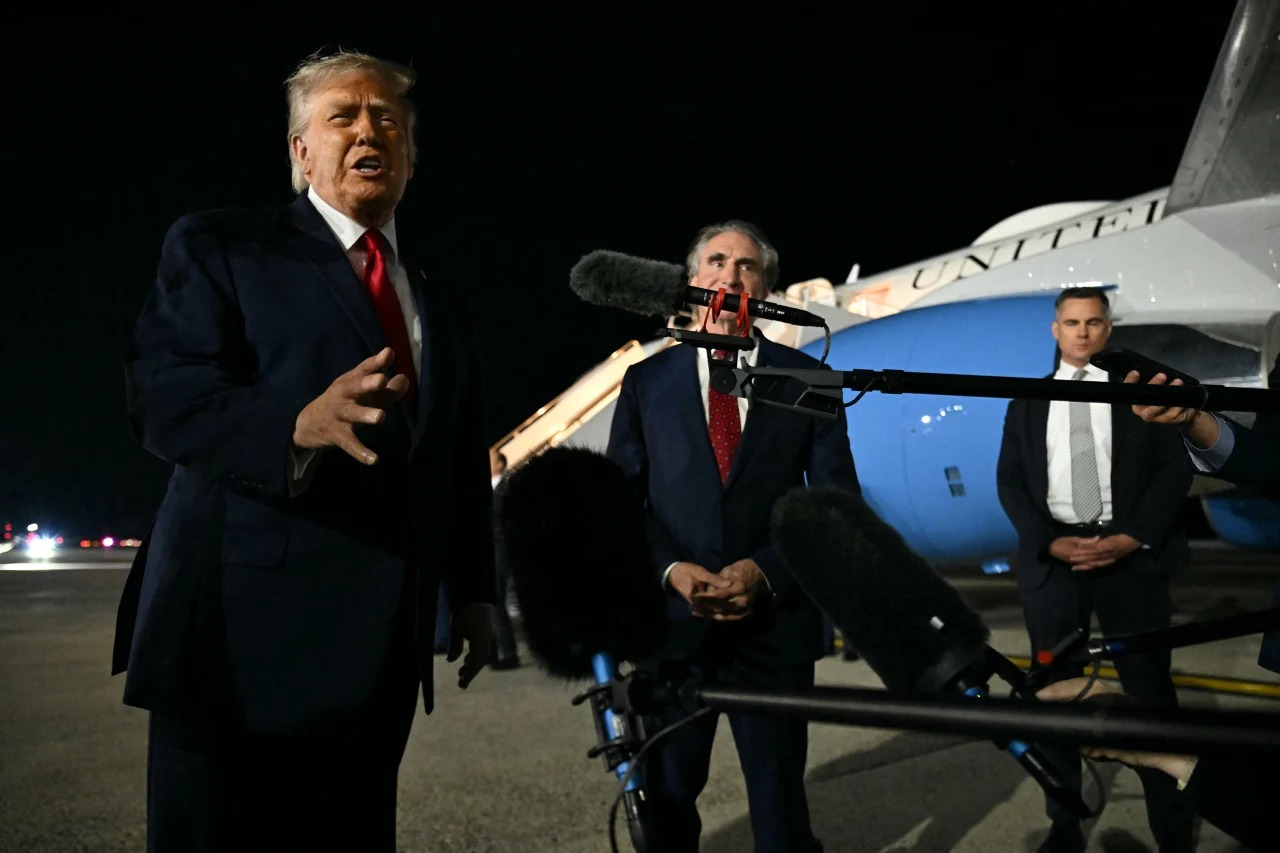
Tensions in the Middle East remain high after President Donald Trump stated that an American military helicopter was brought down near the Strait of Hormuz, prompting warnings that the United States may respond.
The incident comes amid a fragile ceasefire between Iran and Israel, raising concerns that the region could once again move toward a broader confrontation.
Trump Announces Military Incident
President Trump said he had been informed by military officials that an Apache helicopter operating near the Strait of Hormuz had been shot down.
According to his statement, both crew members survived the incident and were rescued safely.
Crew Members Reportedly Safe
Officials indicated that the helicopter’s two pilots were recovered without injuries after a rescue operation.
The event represents a significant military development at a time when tensions between Washington and Tehran remain elevated.
Trump stated that the United States would be required to respond to the incident, though no specific details regarding potential actions were immediately provided.
Ceasefire Holds Despite New Tensions
The reported helicopter incident comes shortly after Iran and Israel restored a ceasefire following a dangerous exchange of missile attacks.
The recent hostilities had raised fears of a wider regional conflict involving multiple countries and military forces.
Fragile Stability
Although active fighting has largely paused, leaders on both sides have warned that renewed military action remains possible if ceasefire terms are violated.
Regional observers continue to monitor developments closely as diplomatic efforts seek to preserve stability.
Casualties Reported in Recent Attack
Iranian media reported that three individuals were killed in an attack earlier this week.
According to reports, two of the victims were members of the country’s air defense forces who were participating in operations related to protecting Iranian airspace.
A third casualty was identified as a municipal employee.
Ongoing Security Concerns
The deaths highlight the continuing security challenges facing the region despite efforts to reduce tensions.
Military officials and political leaders continue evaluating the impact of recent attacks and ceasefire arrangements.
Economic Pressure Growing Inside Iran
Beyond military developments, the conflict has intensified economic difficulties already facing Iran.
Residents have described rising prices, reduced business activity, and increasing financial uncertainty as the conflict affects daily life.
Businesses Face Challenges
Many business owners report declining sales and weaker consumer spending.
At the same time, inflation continues to place pressure on households struggling to afford essential goods and services.
Citizens interviewed across Tehran described concerns about:
- Rising food costs.
- Inflation.
- Reduced purchasing power.
- Economic uncertainty.
- Business slowdowns.
- Future financial stability.
Despite these challenges, some business owners remain hopeful that conditions will improve if stability returns.
Poverty Concerns Increase
Economic analysts warn that prolonged instability could push additional families into financial hardship.
Years of sanctions, inflation, and economic challenges had already weakened living standards before the latest conflict.
The recent fighting has increased uncertainty regarding employment, investment, and future growth prospects.
Daily Life Impacted
Many residents describe the conflict’s consequences as extending far beyond military matters.
Families continue dealing with higher costs, reduced opportunities, and concerns about future economic conditions.
For many citizens, the focus remains on maintaining stability and supporting their families through difficult circumstances.
Diplomatic Efforts Continue
Despite ongoing tensions, discussions aimed at reducing conflict appear to be continuing.
President Trump indicated that negotiations with Iran could produce progress in the near future.
Potential Agreement Under Discussion
According to Trump, ongoing talks could potentially address concerns surrounding Iran’s nuclear activities and regional security issues.
While no agreement has been finalized, diplomatic channels remain active as both sides evaluate possible next steps.
Observers caution that negotiations remain sensitive and could be influenced by military developments on the ground.
Strategic Importance of the Strait of Hormuz
The Strait of Hormuz remains one of the world’s most important shipping routes.
A significant portion of global energy supplies passes through the narrow waterway, making stability in the region a matter of international concern.
Global Economic Implications
Any disruption to maritime traffic in the area could affect:
- Global energy markets.
- International trade.
- Shipping routes.
- Oil prices.
- Economic stability.
- Regional security.
As a result, developments in the Gulf region are closely watched by governments and financial markets around the world.
Looking Ahead
The coming days may prove critical as military leaders, diplomats, and policymakers assess recent events and determine how to proceed.
While the ceasefire between Iran and Israel remains in place for now, ongoing incidents demonstrate how quickly tensions can escalate.
Observers continue to watch for signs of further military responses, diplomatic breakthroughs, or renewed efforts to maintain regional stability.
Key Takeaways
- President Trump reported that a US Apache helicopter was brought down near the Strait of Hormuz.
- Both crew members were rescued safely and were reportedly unharmed.
- The incident occurred during a fragile ceasefire between Iran and Israel.
- Iranian media reported three fatalities from a recent attack.
- Economic conditions inside Iran continue to worsen amid ongoing tensions.
- Diplomatic efforts aimed at reaching a broader agreement remain active.
As military and diplomatic developments unfold, the situation remains one of the most closely watched geopolitical issues in the world, with implications extending far beyond the Middle East.