
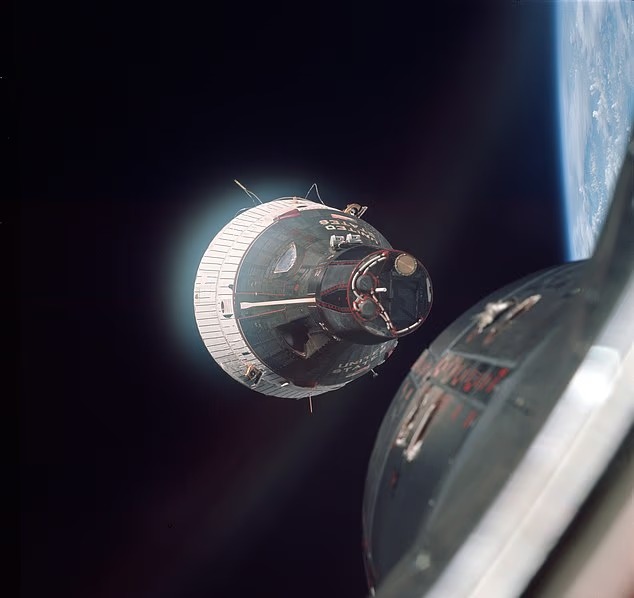
A newly released NASA recording has revived one of the most famous astronaut UFO debates from the Gemini era. The audio captures Gemini 7 astronauts Frank Borman and Jim Lovell speaking with mission control in 1965 after spotting what Borman called a “bogey” outside their spacecraft. The exchange has excited UFO believers because the object was described as bright, separate from the booster, and surrounded by countless small particles. But space historians and skeptics say the most likely explanation is debris connected to the mission, not proof of alien life.
Gemini 7 Astronauts Reported a “Bogey” in Orbit
The Gemini 7 sighting happened on December 5, 1965, during one of NASA’s most important early crewed space missions. Frank Borman and Jim Lovell were orbiting Earth when Borman radioed mission control and reported a “bogey” at “10 o’clock high.”
In aviation language, “bogey” usually means an unidentified object. That word alone helped turn the moment into a long-running UFO mystery.
Mission control asked whether Borman was seeing the Gemini spacecraft’s own booster rocket or a natural sighting. Borman responded that there was debris nearby and called it an “actual sighting.”
The detail that made the exchange more interesting was that the astronauts also said they could see the booster separately. That led many UFO enthusiasts to argue that the object must have been something else.
Jim Lovell Described a Brilliant Object
Jim Lovell, who later became famous as commander of Apollo 13, also described what he saw during the Gemini 7 exchange. According to the released transcript, Lovell said he had the booster on his side but also saw a bright object ahead of them.
He described it as a brilliant body against the black background of space, with countless small particles around it.
That image is exactly why the story has resurfaced so strongly. A bright tumbling object surrounded by particles sounds mysterious, especially when heard in a historic NASA transmission.
But unusual does not automatically mean alien. Space missions often involve boosters, panels, ice particles, vented material, and small debris that can look strange in sunlight.
In orbit, even tiny particles can shine brightly against the darkness of space.
Why the Audio Was Released Now
The audio and transcript were included in a broader government release of UFO and UAP-related files. The new release includes more than 160 documents, images, videos, and recordings connected to unidentified aerial or anomalous phenomena.
Officials have framed the release as part of a transparency effort, allowing the public to review historic files and decide what they think.
For UFO researchers, the Gemini 7 audio is exciting because it gives listeners direct access to the astronauts’ own words.
For skeptics, the release is interesting but not shocking. They argue that many older space sightings have already been discussed for decades and often have ordinary explanations.
The release does not prove alien visitors, recovered alien technology, or a hidden space cover-up. It simply brings old material back into public view.
Why Skeptics Point to Space Debris
Skeptics often point to space debris because Gemini 7 was flying in an environment where small objects from the mission could easily be visible. Booster-related debris, ice crystals, insulation fragments, or vented particles can all reflect sunlight in strange ways.
Space historian James Oberg has argued that the Gemini 7 “bogey” comments likely referred to booster-associated debris rather than an alien craft. Later accounts also say Frank Borman himself rejected the idea that what he saw was an alien UFO.
This explanation fits several parts of the transcript. The astronauts mentioned many small particles, movement relative to the spacecraft, and the booster being visible nearby.
That does not make the sighting meaningless. It shows how difficult visual identification can be in orbit, especially during early space missions when crews were still learning what objects looked like outside a spacecraft.
Why UFO Believers Still Find It Compelling
UFO believers still find the Gemini 7 sighting compelling because the astronauts were trained observers, not random witnesses. Borman and Lovell were experienced military pilots and NASA astronauts operating in one of the most controlled environments possible.
Supporters of the UFO interpretation argue that if the astronauts said they saw something separate from the booster, their report should be taken seriously.
They also point to the language used in the transcript, especially “bogey” and “actual sighting,” as evidence that the crew thought they were seeing something unusual.
That is why the case remains popular in UFO discussions. It has credible witnesses, mission-control audio, and a dramatic setting in Earth orbit.
Still, credibility does not guarantee an extraordinary explanation. Good witnesses can see real objects that remain difficult to identify without full tracking data.
Why Space Sightings Are So Hard to Interpret
Space sightings are hard to interpret because objects move differently in orbit than they do on Earth. A small piece of debris can appear to drift, tumble, shine, or move strangely depending on sunlight, spacecraft motion, and viewing angle.
Distance is also difficult to judge. Something very small and close can appear similar to something larger and farther away.
Astronauts may also see particles released from their own spacecraft. Water dumps, fuel venting, ice crystals, and detached fragments have all created unusual visual effects during space missions.
In the Gemini era, astronauts were working with limited cameras, sensors, and real-time analysis compared with modern missions.
That means some reports can remain visually strange even if the most likely explanation is ordinary mission-related material.
Why the Gemini 7 Mission Was Historic
Gemini 7 was already historic before the UFO debate. The mission launched on December 4, 1965, with Frank Borman and Jim Lovell aboard.
The crew spent nearly 14 days in orbit, setting a major endurance record at the time. The mission helped NASA learn whether astronauts could survive and function during longer spaceflights, which was essential for the later Apollo moon program.
Gemini 7 also became part of the first crewed space rendezvous when Gemini 6A approached it in orbit later that month.
Because of that importance, any unusual moment from the mission naturally attracts attention.
The “bogey” exchange is only one small part of a much larger mission, but it remains one of the most memorable because it connects NASA history with the mystery of UFOs.
Key Takeaways
- Newly released audio captured Gemini 7 astronauts discussing an unidentified object in orbit in 1965.
- Frank Borman called the object a “bogey” during a transmission with mission control.
- Jim Lovell described a bright object against space with countless small particles around it.
- The exchange was included in a new release of government UFO and UAP-related files.
- UFO believers see the recording as compelling because the witnesses were trained astronauts.
- Skeptics argue the most likely explanation is booster-related debris or other mission material.
- The release does not prove alien life, but it does revive one of NASA’s most discussed space mysteries.
The Gemini 7 audio is fascinating because it captures real astronauts reacting to something unusual in orbit. But for now, the strongest explanation remains space debris rather than alien technology.